Is THCA Legal in Texas? The Complete 2026 Guide
🔍 Quick Answer: Yes — THCA derived from hemp is currently legal in Texas. But the story behind why it’s legal, how that could change, and what it means for consumers is more nuanced than a simple yes or no. Here’s everything you need to know.
Walk into any hemp shop in Dallas, Houston, or Austin right now and you’ll find shelves lined with THCA flower, THCA vapes, and THCA concentrates — products that look, smell, and function almost identically to marijuana. Yet they’re sold legally, in broad daylight, to anyone over 21.
How is that possible? And more importantly — is THCA legal in Texas, and will it stay that way?
These are questions a lot of Texans are asking in 2026, and the answers matter whether you’re a curious consumer, a business owner, or someone who just got handed a product at a party and wants to know if you’re about to break the law. This guide cuts through the noise and gives you the full, accurate picture.
What Is THCA? (And Why It’s Not the Same as THC)
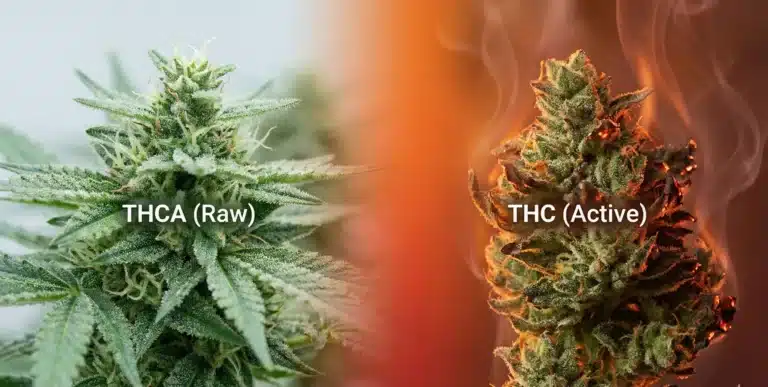
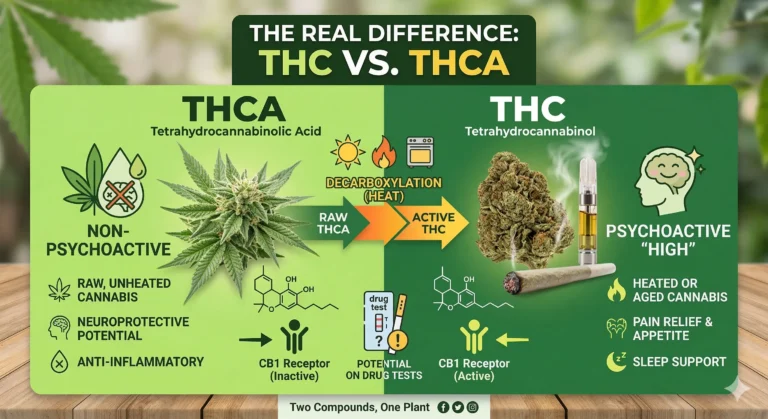
THCA stands for tetrahydrocannabinolic acid. It is the raw, naturally occurring form of THC found in the live cannabis plant — and in its unaltered state, it is not psychoactive. You could eat a raw THCA flower bud and feel nothing. No high, no impairment.
The intoxicating effect only kicks in through a process called decarboxylation — the application of heat. When you smoke, vape, or cook THCA, the heat strips away a carboxyl group from the molecule, converting it into Delta-9 THC, the compound responsible for the classic cannabis high.
This chemical distinction — THCA vs. Delta-9 THC — is the entire foundation of THCA’s legal status in Texas and across most of the country. It’s not a loophole, exactly. It’s a direct consequence of how federal hemp law was written.
THCA vs. THC: The Key Differences
| Property | THCA vs. Delta-9 THC |
|---|---|
| Psychoactive? | THCA: No (raw). Delta-9 THC: Yes |
| Found in raw hemp? | Yes — THCA is the dominant cannabinoid in fresh flower |
| Converts to THC? | Yes — via heat (smoking, vaping, cooking) |
| Legal under Farm Bill? | THCA: Yes, if hemp-derived. Delta-9 THC: Only at ≤0.3% by dry weight |
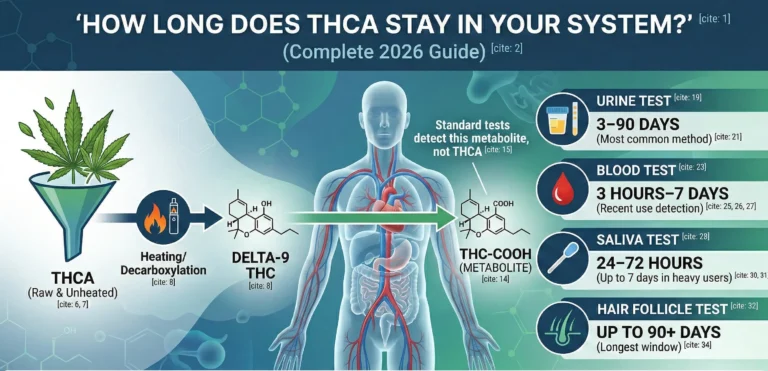
| Detected on drug tests? | Yes — once consumed and metabolized, both show the same metabolites |
Is THCA Legal in Texas? Here’s Where the Law Actually Stands
THCA is legal in Texas. That’s the current legal reality as of 2026 — but understanding why requires a quick look at two pieces of legislation that reshaped the entire hemp industry.
The 2018 Federal Farm Bill
Congress passed the Agricultural Improvement Act of 2018, commonly known as the Farm Bill, which removed hemp from the federal list of controlled substances. The law defined legal hemp as cannabis containing no more than 0.3% Delta-9 THC on a dry weight basis.
Notice what that definition is based on: Delta-9 THC specifically. Not total THC. Not THCA. Just Delta-9. This meant that a hemp plant could legally contain very high levels of THCA — sometimes exceeding 20% — as long as its Delta-9 THC content stayed under 0.3% at the time of testing.
Texas House Bill 1325 (2019)
Texas aligned with the federal framework through HB 1325, signed into law by Governor Greg Abbott in June 2019. The bill established Texas’s hemp program, adopted the federal Delta-9 definition, and authorized the Texas Department of Agriculture (TDA) to regulate hemp cultivation and sales.
From that point forward, hemp-derived THCA products became legal to produce, sell, and possess in Texas — and that status has not been revoked by any law passed since.
⚠️ Important: THCA derived from marijuana (not hemp) is still a controlled substance in Texas. The legality hinges entirely on the source plant testing below 0.3% Delta-9 THC. Always verify a Certificate of Analysis (COA) before purchasing.
How Is THCA Legal in Texas When It Converts to THC?
This is the question that trips most people up — and honestly, it’s a fair one. If THCA turns into psychoactive THC the moment you light it, how is it legal to sell in a state that still criminalizes marijuana?
The answer is both technical and legal. Let’s break it down.
The Testing Window Problem
Hemp compliance testing is done on the harvested plant before it reaches consumers. Labs measure the Delta-9 THC content at that specific moment in time, before any heat is applied. If the flower tests at, say, 22% THCA and 0.2% Delta-9 THC, it passes as legal hemp — even though anyone who smokes it will experience something very similar to traditional marijuana.
This is sometimes called the “pre-decarboxylation” testing standard. Some states have shifted to a “total THC” formula — which adds THCA × 0.877 (the conversion factor) to Delta-9 THC to get a theoretical post-decarboxylation number. Under that standard, most THCA flower would exceed the 0.3% limit instantly. Texas has not adopted total THC testing as of 2026.
Why Hasn’t Texas Closed the “THCA Loophole”?
Texas lawmakers have introduced multiple bills over the past several sessions attempting to restrict THCA products by changing the testing standard or explicitly banning high-THCA hemp. None have become law. Several factors contribute to this:
Industry lobbying: The Texas hemp industry generates hundreds of millions of dollars in revenue annually. Retailers, farmers, and distributors have organized effectively to oppose restrictive legislation.
Agricultural interests: Texas is a major hemp-producing state, and farmers who grow high-THCA cultivars would be directly harmed by a ban.
Legislative calendar: The Texas Legislature only meets in regular session every two years (odd-numbered years), limiting how quickly laws can change.
Definitional uncertainty: Some lawmakers and legal experts argue that banning THCA requires a more complex rewriting of statute than simply amending testing standards.
💡 Pro Tip: Because Texas only has regular legislative sessions in odd-numbered years (2025 was the most recent), no new hemp restrictions can take effect via the regular process until 2027 at the earliest — unless a special session is called.
THCA Flower in Texas: What It Is, Where to Get It, What to Know
THCA flower is the most visible and widely discussed THCA product on the market — and the one generating the most legal debate. If you’ve walked into a hemp store recently, you’ve probably seen it: dense, aromatic buds that look and smell virtually identical to marijuana, packaged in glass jars with colorful labels and strain names.
Here’s what you actually need to know about buying and using THCA flower in Texas.
What Makes THCA Flower Different from Marijuana?
Legally, everything. Practically, very little — at the point of consumption.
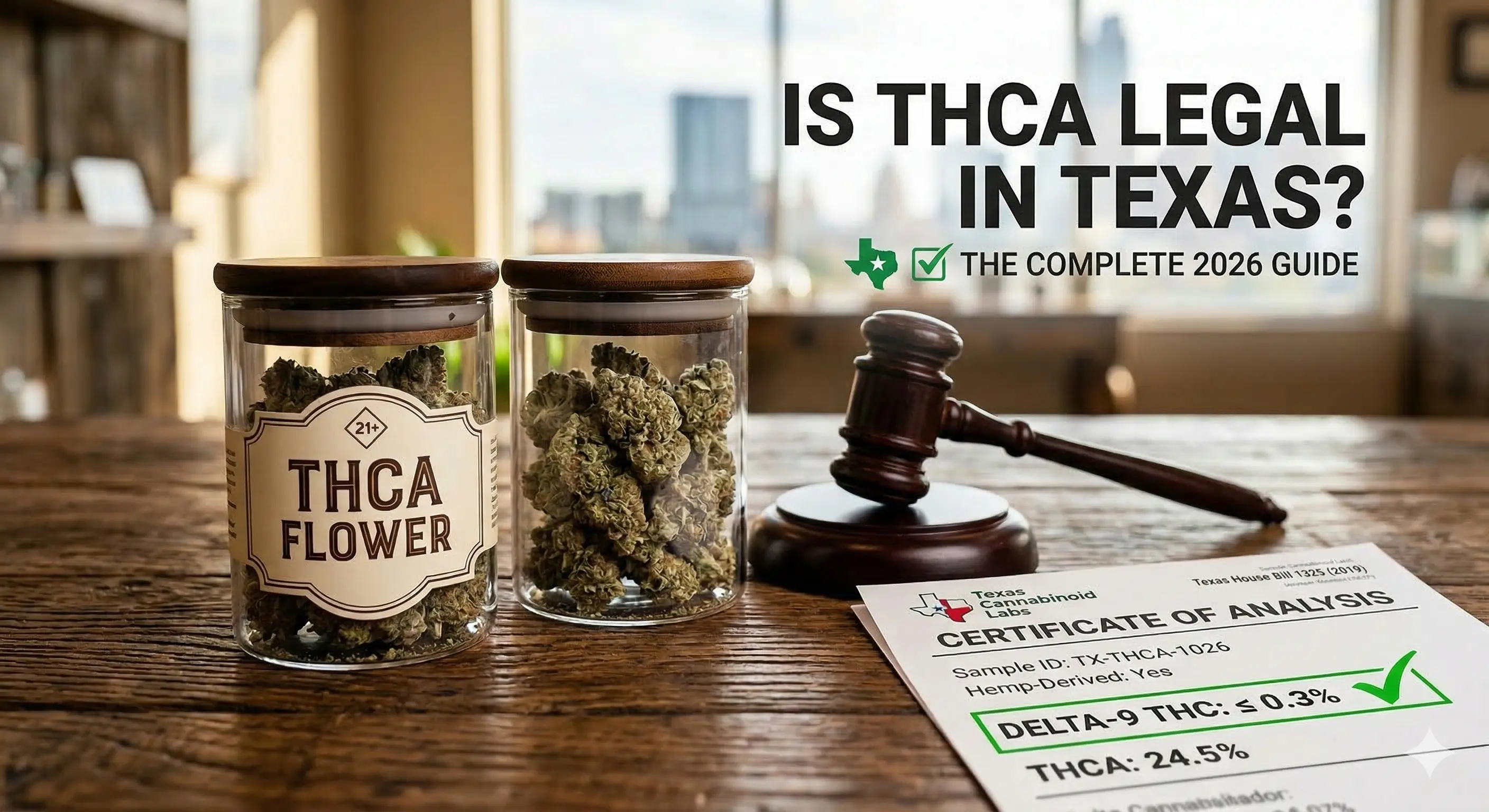
THCA flower is harvested from hemp plants selectively bred to produce high THCA content while keeping Delta-9 THC below the 0.3% threshold. The cultivation, processing, and sale of that flower is licensed and regulated by the Texas Department of Agriculture. A compliant product will come with a third-party lab COA showing the cannabinoid breakdown.
When that same flower is smoked or vaped, decarboxylation occurs and the user experiences effects very similar to marijuana. This is the reality of THCA flower — and it’s why the product sits in such a politically contentious space.
Popular THCA Flower Product Types in Texas
Raw flower (loose bud, typically sold by the gram or eighth)
Pre-rolled joints and infused pre-rolls
THCA vape cartridges and disposable pens
THCA wax, shatter, and live resin concentrates
Hash and kief products derived from THCA hemp
How to Buy THCA Flower Safely in Texas
Not all THCA products are created equal. The market is largely unregulated at the retail level, which means product quality and compliance can vary significantly. Here’s how to protect yourself:
Always ask for the COA: A Certificate of Analysis from an accredited, ISO-certified third-party lab should accompany every THCA product. It should show cannabinoid percentages including Delta-9 THC (must be ≤0.3%), THCA percentage, and ideally a terpene profile and residual solvent testing.
Check the QR code: Reputable brands embed QR codes on packaging that link directly to the current lab report. If there’s no QR code or the link is broken, walk away.
Know the source: Look for products labeled as “USA-grown hemp” and avoid unlabeled or imported flower with no clear origin.
Buy from licensed retailers: Businesses selling hemp products in Texas should be operating under state authorization. Established hemp shops and reputable online retailers are safer bets than gas stations or flea market vendors.
💡 Pro Tip: Keep a digital or physical copy of your COA when carrying THCA flower. Texas law enforcement lacks field-test technology to distinguish compliant hemp from marijuana, and possession can create complications — even if you’re legally in the clear.
Why Is THCA Legal in Texas? The Bigger Picture
Beyond the legal technicalities, there’s a broader story worth understanding about why THCA exists as a legal product category at all — and what it tells us about where cannabis policy is heading.
The 2018 Farm Bill was primarily written to support hemp farmers and the industrial hemp industry: fiber, seed, and CBD production. The authors almost certainly did not anticipate that it would also legalize a product functionally equivalent to recreational marijuana in states where that remains illegal. But that’s exactly what happened.
High-THCA hemp occupies a strange legal position: it is federally compliant as written, sold openly in states with strict anti-marijuana laws, and consumed by millions of Americans who are effectively purchasing something with near-identical effects to marijuana — just from a different legal category of the same plant.
Texas is a particularly striking example because the state has historically resisted marijuana legalization at every turn. Yet THCA flower is sold openly in hundreds of retail locations statewide. That tension is why THCA legislation keeps resurfacing in Austin — and why the debate is unlikely to go away anytime soon.
The States That Have Banned THCA (And What Texas Could Learn)
Several states have moved to restrict or outright ban THCA products, primarily by adopting total THC testing standards. These include states like Oregon, which implemented total THC testing for hemp, and others that have explicitly added THCA to their lists of controlled substances. In each case, the move had significant economic consequences for local hemp retailers and farmers.
Whether Texas follows this path — or carves out a unique regulatory framework that acknowledges the realities of the current hemp market — remains to be seen. What’s clear is that the current legal gray zone is unlikely to be permanent.
Is It Legal to Smoke THCA in Texas?
Yes — smoking or vaping THCA in Texas is currently legal, provided the product itself is a compliant, hemp-derived THCA product. There is no Texas statute that specifically prohibits the consumption of legal hemp THCA.
That said, there are practical and legal nuances that every consumer should understand before lighting up.
The “Identical to Marijuana” Problem
The single biggest practical challenge for THCA consumers in Texas is that THCA flower is visually, aromatically, and chemically (post-combustion) indistinguishable from marijuana. Standard law enforcement drug tests react to THC metabolites — not to whether a product was originally hemp or marijuana.
This creates a real risk: a police officer who observes someone smoking what appears to be marijuana cannot, in the field, determine whether the product is legal THCA hemp or illegal marijuana. In practice, this has led to arrests and charges that were subsequently dismissed — but the process is stressful, time-consuming, and legally expensive.
Where You Cannot Smoke THCA in Texas
In vehicles while driving: Driving under the influence of any intoxicating substance, including decarboxylated THCA, is illegal under Texas DWI law.
In government buildings and schools: Standard no-smoking and no-drug policies apply regardless of the legal status of the substance.
On federal property: THCA remains in a complex federal status; consumption on federal land is not advisable.
In spaces with local restrictions: Some Texas municipalities have additional smoking ordinances that may apply.
⚠️ Important: Even if you’re legally carrying THCA flower, being stopped by law enforcement while smelling of cannabis can lead to a complicated encounter. Carry your COA, keep your receipt, and know your rights as a Texas citizen.
The 2026 THCA Legislative Landscape in Texas: What’s Happening Now
If you want to understand where THCA legality in Texas is heading, you need to pay attention to what’s happening in the Texas Legislature right now.
The 89th Texas Legislative Session, which convened in January 2025 and runs into 2026, has seen renewed attempts to address what critics call the “hemp loophole.” Here’s a summary of the current landscape:
Bills to Watch
Total THC testing proposals: Legislation that would require hemp to be tested using a total THC formula (THCA × 0.877 + Delta-9 THC) has been introduced in multiple recent sessions. If passed, this would effectively ban most THCA flower and concentrates currently on the market.
Age restriction bills: Several proposals would mandate a minimum age of 21 for purchasing hemp-derived cannabinoid products, including THCA.
Retail licensing requirements: Some bills propose stricter licensing and inspection requirements for hemp retailers — potentially forcing smaller or non-compliant shops out of business.
As of early 2026, no legislation from the 89th session has been signed into law that restricts THCA. But the session is active, and the political will to regulate this category more tightly is clearly present in Austin.
What Would Change If THCA Is Restricted in Texas?
Most THCA flower would immediately become illegal. Products that currently test at 20%+ THCA would fail a total THC test by a wide margin.
Retailers would need to rapidly change their inventory. Hundreds of hemp shops across Texas would need to pivot to low-THCA products or face legal exposure.
Prices for remaining compliant products would likely rise. Scarcity and reformulation costs would be passed to consumers.
Online purchases would also be affected. Shipping non-compliant THCA products into Texas after a legal change would be treated as drug trafficking.
Is THCA Legal in Texas? Quick Reference Guide
| Question | Current Answer (2026) |
|---|---|
| Is THCA legal in Texas? | Yes — hemp-derived THCA is legal under current state and federal law. |
| Is THCA flower legal in Texas? | Yes — when tested below 0.3% Delta-9 THC and derived from licensed hemp. |
| Is it legal to smoke THCA in Texas? | Yes — but practical risks around law enforcement and DWI laws apply. |
| Is THCA a controlled substance in TX? | No — not when hemp-derived. Marijuana-sourced THCA is still illegal. |
| Why is THCA legal in Texas? | Farm Bill defines hemp by Delta-9 THC only; THCA is a separate compound. |
| Can you buy THCA online in Texas? | Yes — online purchase and shipping of compliant THCA is legal. |
| Will THCA become illegal in Texas? | Possible — active legislative efforts to restrict THCA exist in 2026. |
| Does THCA show on a drug test? | Yes — once consumed, THCA metabolizes identically to THC on tests. |
| Is growing THCA hemp legal in Texas? | Yes — with a Texas Department of Agriculture hemp license. |
Frequently Asked Questions
If THCA converts to THC when smoked, isn’t it just marijuana?
Chemically, the end result is similar. Legally, the distinction is everything. Federal and Texas law classify substances based on their chemical composition at the time of testing — not what they become after consumption. THCA hemp is tested before any heat is applied, and if it meets the Delta-9 threshold, it is legally hemp. Whether that framework makes sense from a policy standpoint is a debate actively happening in Austin — but as of today, the law draws a clear line.
Can I travel with THCA flower in Texas?
You can legally carry THCA flower within Texas, but traveling by air is a different matter. The TSA and federal aviation authorities operate under federal jurisdiction, and while hemp is federally legal, TSA agents are not required to make distinctions between hemp and marijuana. Travel by car within the state is generally fine — keep your COA and receipt with you.
What’s the difference between THCA and Delta-8?
Both are hemp-derived cannabinoids that occupy a similar legal gray area. Delta-8 THC is a psychoactive isomer of Delta-9 THC, produced through chemical synthesis from CBD. THCA is a naturally occurring precursor to Delta-9 that converts via heat. Both are currently legal in Texas, and both face similar legislative scrutiny. Delta-8 has been banned in several states that THCA has not, and vice versa.
Is CBD different from THCA?
Yes. CBD (cannabidiol) is a non-psychoactive cannabinoid that does not convert to THC. THCA, by contrast, becomes psychoactive when heated. Both are hemp-derived and federally legal under the Farm Bill, but they have very different effects and very different regulatory contexts. CBD products have broader mainstream acceptance and far less legislative controversy.
How do I know if a THCA product is actually compliant?
Ask for the Certificate of Analysis (COA). A compliant THCA product should have a COA from an ISO/IEC 17025 accredited laboratory showing Delta-9 THC at or below 0.3% by dry weight. The COA should also show the batch number matching the product packaging, a recent test date, and a full cannabinoid panel. If a retailer can’t produce a COA on request, don’t buy.
Bottom Line: Is THCA Legal in Texas?
Yes — THCA is legal in Texas in 2026. The current legal framework, rooted in the 2018 federal Farm Bill and Texas HB 1325, permits the sale, purchase, and possession of hemp-derived THCA products including THCA flower, vapes, and concentrates. That has not changed despite repeated legislative attempts to restrict the category.
But “legal right now” and “legal indefinitely” are two different things. Texas lawmakers are actively engaged with this issue, and the regulatory landscape could shift in ways that significantly affect THCA availability. If you operate a business in the hemp space or are a regular consumer, staying current on Texas legislative developments is not optional — it’s essential.
For now, if you’re purchasing THCA products in Texas, buy from reputable licensed retailers, always verify your COA, and carry your documentation. The product in your hand may be completely legal — but in a market this fluid, informed consumers are protected consumers.
Disclaimer: This article is for informational purposes only and does not constitute legal advice. Hemp and cannabis laws are subject to change at any time. Consult a licensed Texas attorney for advice specific to your situation.